
.jpg)
UK fashion is approaching a pressure point. Consumer confidence has dropped, economic uncertainty is tightening discretionary spend, and even the strongest high-street brands are feeling the impact.
Our QuestBrand data shows a category struggling to maintain value perceptions and connect meaningfully with younger consumers. But it also reveals the strategies that are working.
1. Performance leaders face new headwinds
Europe’s largest second-hand marketplace, Vinted, has expanded its reach and doubled down on sustainable initiatives, including the launch of its shipping brand Vinted Go. But despite a year of unprecedented momentum, the brand was hit by a €2.38M fine from Lithuania’s National Data Protection Authority, denting consumer sentiment and confidence just as it began to scale across Europe.
In contrast, Primark is using product strategy and storytelling to increase purchase consideration. Its relaunch of the men’s, women’s, and kids’ athleisure lines – supported by the Unstoppable You campaign – features real athletes, influencers, and mental-health advocates sharing resilience stories. The message is resonating and giving consumers a reason to re-engage with the brand across stores and digital channels.
2. There’s a weakening macro environment
The wider category outlook is subdued. Consultancies Bain and McKinsey both forecast a slowdown for the second half of 2025, as does clothing brand Next. These are driven by falling consumer spend and tightening household budgets. UK sales forecasts are weakening as shoppers deprioritize fashion in favor of essentials. Reuters emphasizes the sector’s vulnerability as luxury and mass retail both brace for softer demand.
This downturn gives brands the chance to:
- Re-anchor around value: not just price cuts, but clearer proof of quality, durability, versatility, or longevity
- Strengthen emotional trust by being transparent: not just with pricing, sustainability, but also product purpose and usefulness
- Innovate in lower-risk ways: Such as capsule drops, repair/refurbish programs, or rental/resale partnerships that signal value without eroding margins.
When the category pulls back, relevance becomes a competitive advantage. Brands that articulate why they’re worth it – and make consumers feel smarter, not poorer, for choosing them – can grow loyalty in a market that’s otherwise shrinking.
3. Fashion is skewing toward higher-income consumers
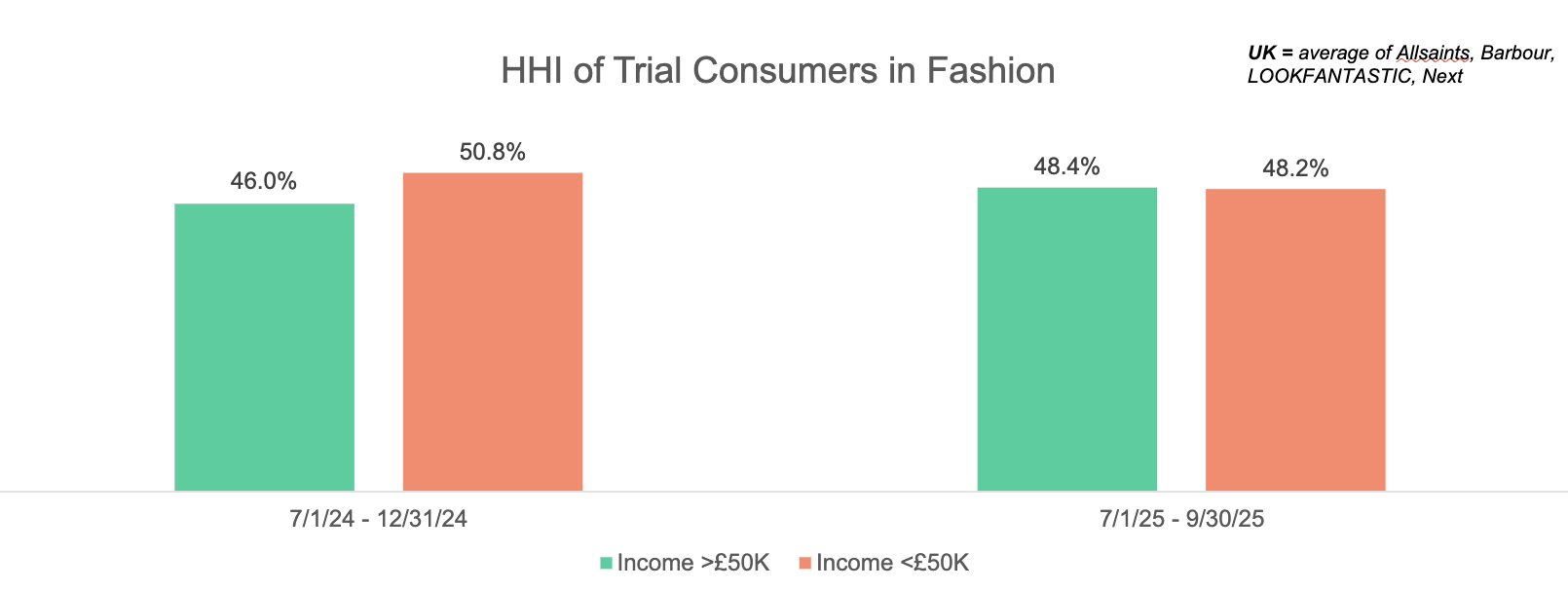
Trial audiences are shifting upward. A rising share of trial users come from households earning more than £50K, indicating that fashion is becoming harder to access – or justify – for everyday consumers.
Brands now face a strategic crossroads: lean further into high-income audiences or rebuild relevance and affordability for households earning under £50K. This shift creates an opening for brands to either double down on higher-income shoppers or differentiate by making fashion feel accessible, worthwhile, and priced for the everyday consumer again.
4. The category has a value problem
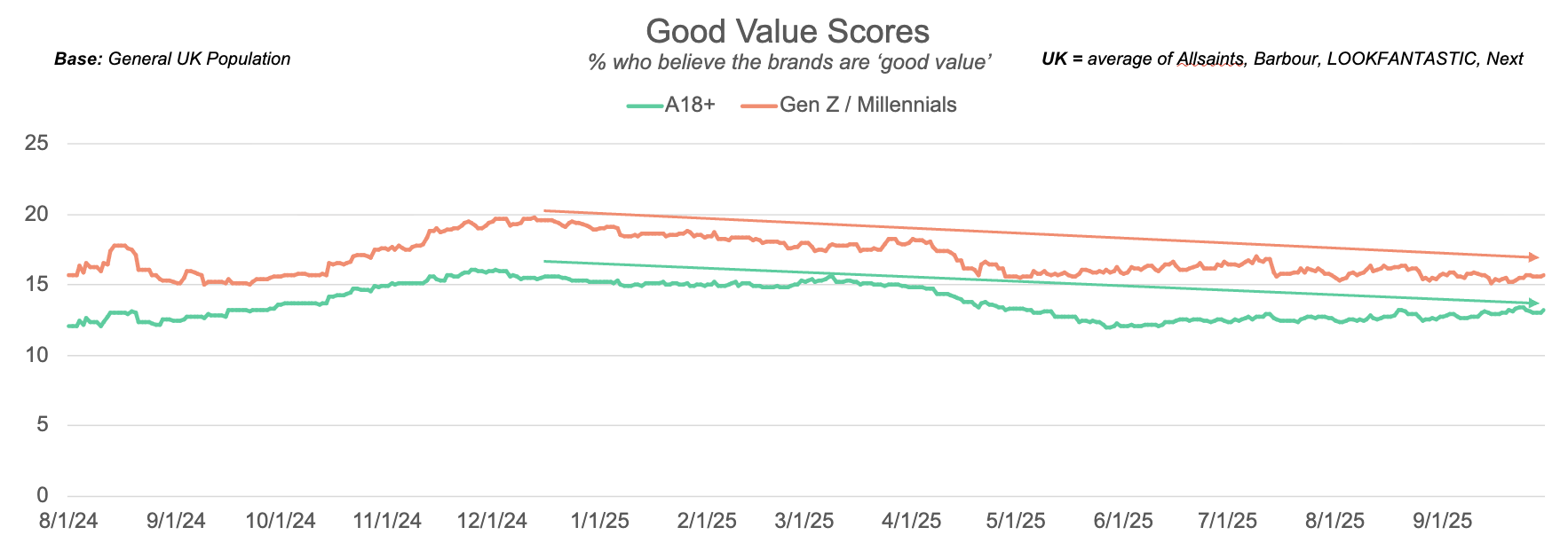
Across the market, Good Value scores are declining among both A18+ consumers and Gen Z / Millennials. This erosion reflects financial anxiety and growing scrutiny of price-to-quality ratios. Brands must work harder to prove worth, demonstrate durability or uniqueness, and articulate why their products justify the spend. Without this, share loss is inevitable – especially among younger shoppers whose value expectations are more elastic and emotionally driven.
5. Next illustrates how economic news impacts perception
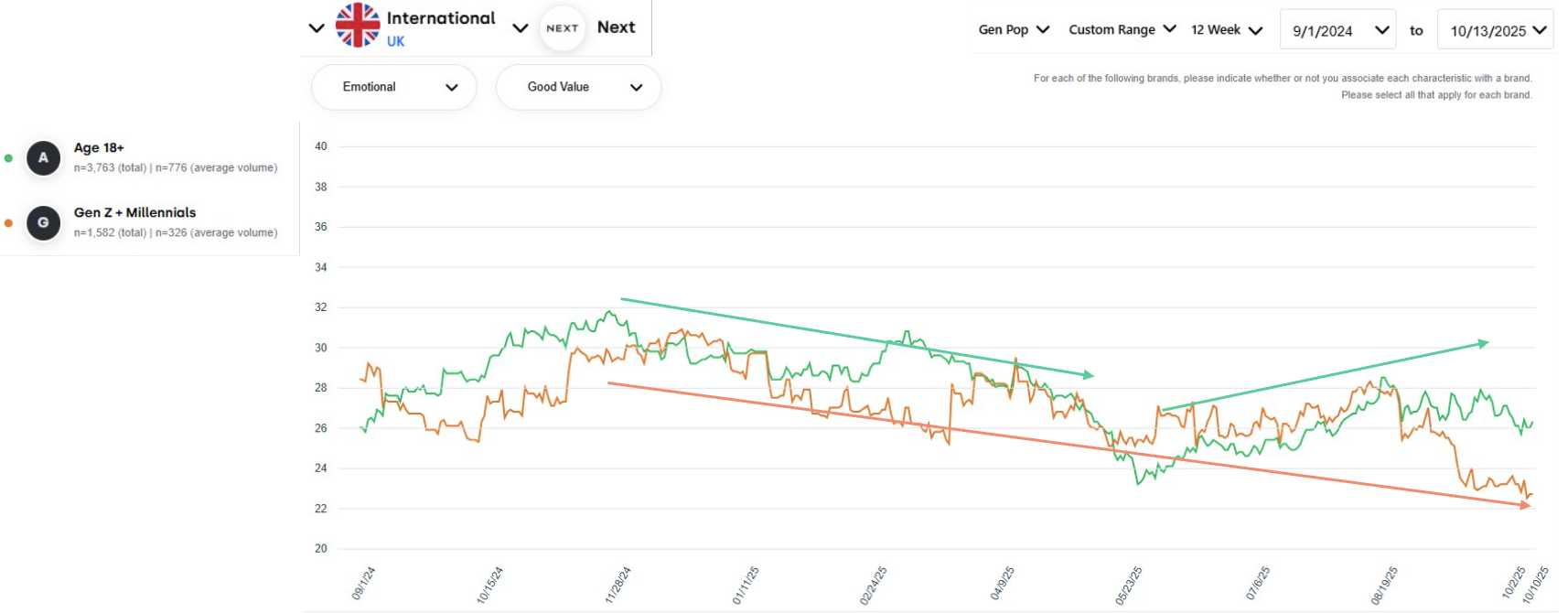
When clothing brand Next communicated caution about a weakening UK trade economy, their Good Value scores among younger shoppers dipped accordingly. A18+ shoppers rose early in 2025 off the back of strong H1 performance. But sentiment reversed sharply when the retailer projected a weakening UK trade environment. Younger consumers (Gen Z and younger Millennials) saw the steepest declines, signalling heightened sensitivity to macroeconomic cues and brand-led economic commentary.
6. How Barbour is bucking the trend
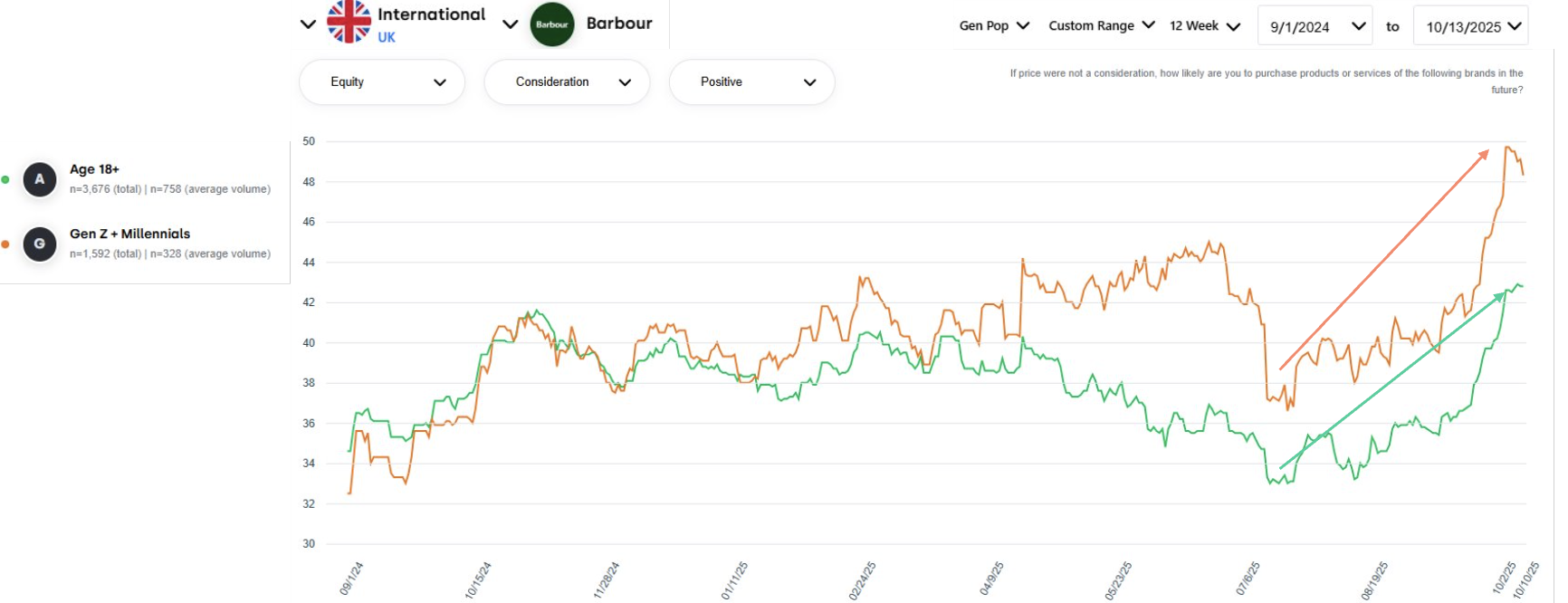
Luxury brand Barbour stands out as a rare bright spot. The brand has grown consideration by launching initiatives that provide tangible reasons to buy – even at premium price points.
These include:
The Re-Loved x Oxfam Barbour collab: Barbour’s collab with charity Oxfam takes worn Barbour wax jackets, restores them, and refreshes them with repurposed materials. The refurbished pieces are sold through select Oxfam stores and at major events such as Glastonbury, with every pound raised supporting the charity.
Ode to Ayrshire brand campaign: Barbour’s “Ode to Ayrshire” campaign pays tribute to the brand’s Scottish origins, drawing inspiration from its historic ties to 13th-century Ayrshire. The work highlights Barbour’s signature tartan – originally created to honor that heritage – and was filmed across the region’s landscapes. The creative blends classic and modern aesthetics and spotlights emerging British talent to bring the story to life.
The Barbour x FARM Rio collaboration: The Barbour x FARM Rio collab fuses Barbour’s storied British country-heritage craftsmanship with FARM Rio’s tropical-inspired, vibrant Brazilian design energy — creating a collection where countryside practicality meets bold print and color. This works because it modernizes a heritage brand without breaking its DNA. Classic waxed and quilted silhouettes remain intact, but the tropical prints and bolder palette make them feel fashion forward rather than nostalgic.
These sustainability and bold fashion activations are attracting younger consumers and driving a clear upward trajectory in consideration among both A18+ and Gen Z/Millennials in the UK.
Why Barbour is positioned to win
Compared with Next, Barbour scores significantly higher across the emotional attributes that matter most during economic uncertainty. Gen Z and Millennial consumers view the brand as more sophisticated, premium, innovative, bold, trustworthy, and dependable. These attributes form a resilience moat – helping Barbour maintain momentum even as the wider sector struggles to sustain value perceptions.
How QuestBrand can help right now
In a market defined by uncertainty, the brands winning are those who stay closest to their consumers. That’s where the Quest platform becomes essential. With QuestBrand always-on brand intelligence and QuestDIY's rapid research, we help retailers and fashion brands track sentiment, understand shifting value perceptions, and validate new ideas with confidence. HarrisQuest gives fashion brands a single, connected system to meet all their research needs, and turn fast-changing consumer behavior into clearer decisions and smarter growth.