

LGBTQ+ adults have strong opinions about brands. They notice who shows up, who stays quiet, and who shows up only in June. So it is striking that when you ask them which brands are coolest in America, their list looks almost identical to everyone else's: Owala, Poppi, Depop, OLIPOP, Oura Ring. Trust is where it comes apart.
Which brands are coolest according to LGBTQ+ adults?
What makes a brand "cool"?
Look at the top of the list and a pattern emerges fast. These brands are hip, and they're socially tuned in. Coolness carries social currency, and it rewards more than just being good. The brands that score highest manage both at once. They feel current, they feel hip, and they feel like they're on the right side of something.
Hip and socially conscious beat heritage every time
We never ask people whether a brand is cool. We infer it. A brand climbs when people call it hip, bold, innovative, and socially conscious, and when they see it as "on the way up." It falls when respondents call it corporate or old-fashioned. The brands at the top earn their place by holding both qualities at once. They're exciting, and they're socially tuned in.
A brand can spend its way into awareness. It cannot spend its way into cultural capital. That has to be earned – through the product, the values, and the consistency of both over time.
Owala: hydration with personality and purpose
Owala tops the list for this audience with a score of 176. Its rise is built on product-first personality: bold colorways, a cult following among younger consumers, and a tone that refuses to take itself too seriously. Its CEO has built the brand around inclusivity and self-expression, with a stated goal of being "the brand that says, 'Come join the party!'" It also carries a quiet values signal – a reusable, design-led alternative in a category dominated by disposables. It's a bottle people want to be seen with, and for this audience, that visibility carries meaning. It reads as joyful, expressive, and unapologetically itself.
Poppi turned soda into a lifestyle object
Poppi took a traditional CPG category and made it something people choose to be seen drinking. The brand pairs candy-bright cans with a gut-health story that reframes "good for you" as fun rather than medicinal, plus a tagline built to flip the category's reputation: "soda that loves you back." It earned that reputation less through traditional advertising than through who got to represent it: a creator roster assembled to be visibly broad – by body size, race, and sexuality – so the brand never reads as built for one narrow customer. A single campaign can't buy that. Poppi built it one creator partnership and one viral can at a time, and it has kept building over time.
Depop turned secondhand clothes into a culture
Depop took the most overlooked corner of fashion – other people's castoffs – and built a marketplace where the product is whoever's selling it: individual shops instead of a corporate catalog, vintage and one-of-a-kind pieces instead of anything restockable, and a feed that runs on personal taste rather than merchandising. It's also a community Depop chose deliberately. In 2019, the brand ran a campaign putting LGBTQIA+ sellers in Texas front and center, treating their shops as success stories rather than a footnote. That mix of hip and principled is exactly what the Cool Index measures, and almost nothing in our dataset captures it more cleanly. Depop scores as one of the least "corporate" brands we track, and that absence is doing real work. A marketplace like this can't be assembled by a brand team. It has to be grown seller by seller, and Depop grew it.
The trust gap
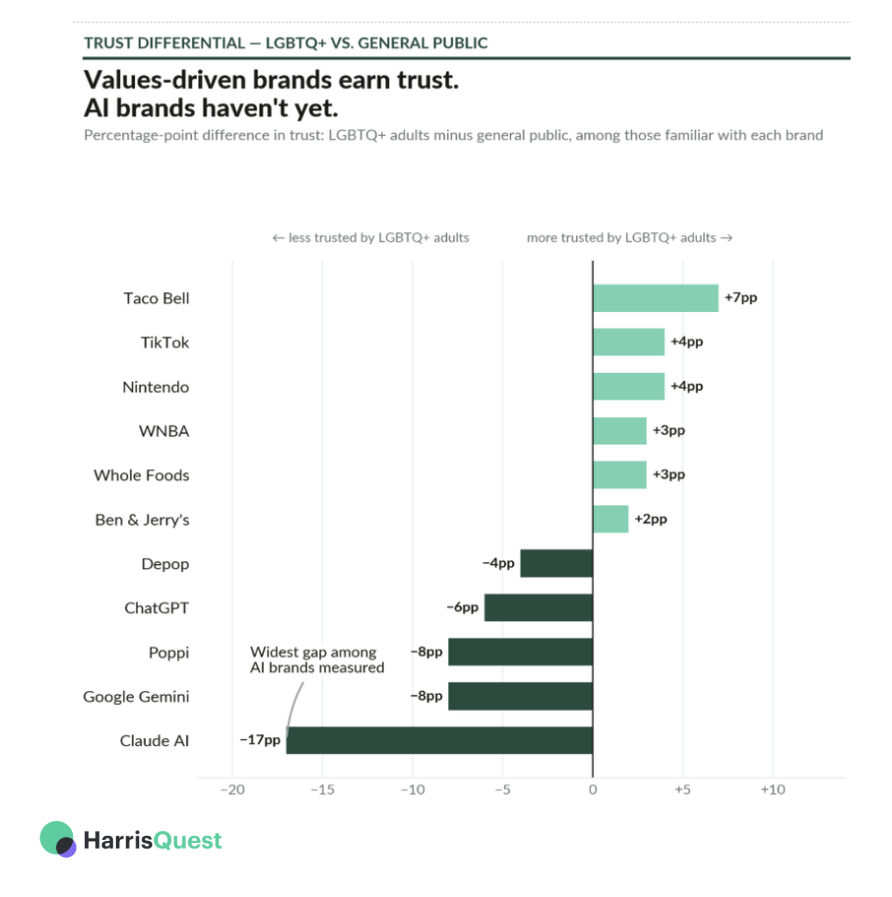
Trust looks different depending on which side of the ledger you're on. We compared trust among LGBTQ+ adults familiar with each brand against the general population familiar with each brand. The pattern is stark.
Brands that have built genuine relationships with LGBTQ+ adults earn trust lifts of 3 to 7 percentage points above the general public – Taco Bell through years of sustained community investment, the WNBA and Ben & Jerry's through consistent public positioning. AI brands sit at the other end entirely. ChatGPT, Google Gemini, and Claude all carry trust scores well below what the general public gives them, with Claude showing the widest gap of any AI brand we measured. The AI names carry the relevance without the trust floor underneath. Cultural capital travels fast, trust travels slow, and with this audience, the gap is widest for brands that have said little about where they stand.
Coolness tells you the signal. Trust tells you the floor.
The brands winning with LGBTQ+ adults aren't necessarily the ones that tried hardest. They're the ones that built something real: a product with a point of view, a value system that shows up outside of June, a community they chose rather than inherited. Cool travels fast and broadly. Trust is slower and more personal. For brands working out where they stand with this audience, the gap between the two is the most important number on the page.
Want to find out where your brand sits in the HarrisQuest Cool Index? Request a demo.
HarrisQuest is The Harris Poll's brand and reputation intelligence platform, measuring how the public sees about 1,600 brands every day.
Source: HarrisQuest. Cool ranking: QuestBrand imagery, LGBTQ+ and US adults familiar with each brand, at least 200 per brand, December 2025 through May 2026; the Cool Index sets 100 as an average brand. Trust and relevance: QuestRQ, familiar respondents, with LGBTQ+ figures centered against the general population to remove the audience's baseline grading difference, so a positive number reflects identity rather than overall skew. Reputation by generation: QuestRQ, US National, Q1 2026.